The Money Objection: When Payment Becomes a Test of Commitment
A coaching prospect wants help but needs to sort out the cost. We examine what the call reveals about fit, money, and a verbal commitment.
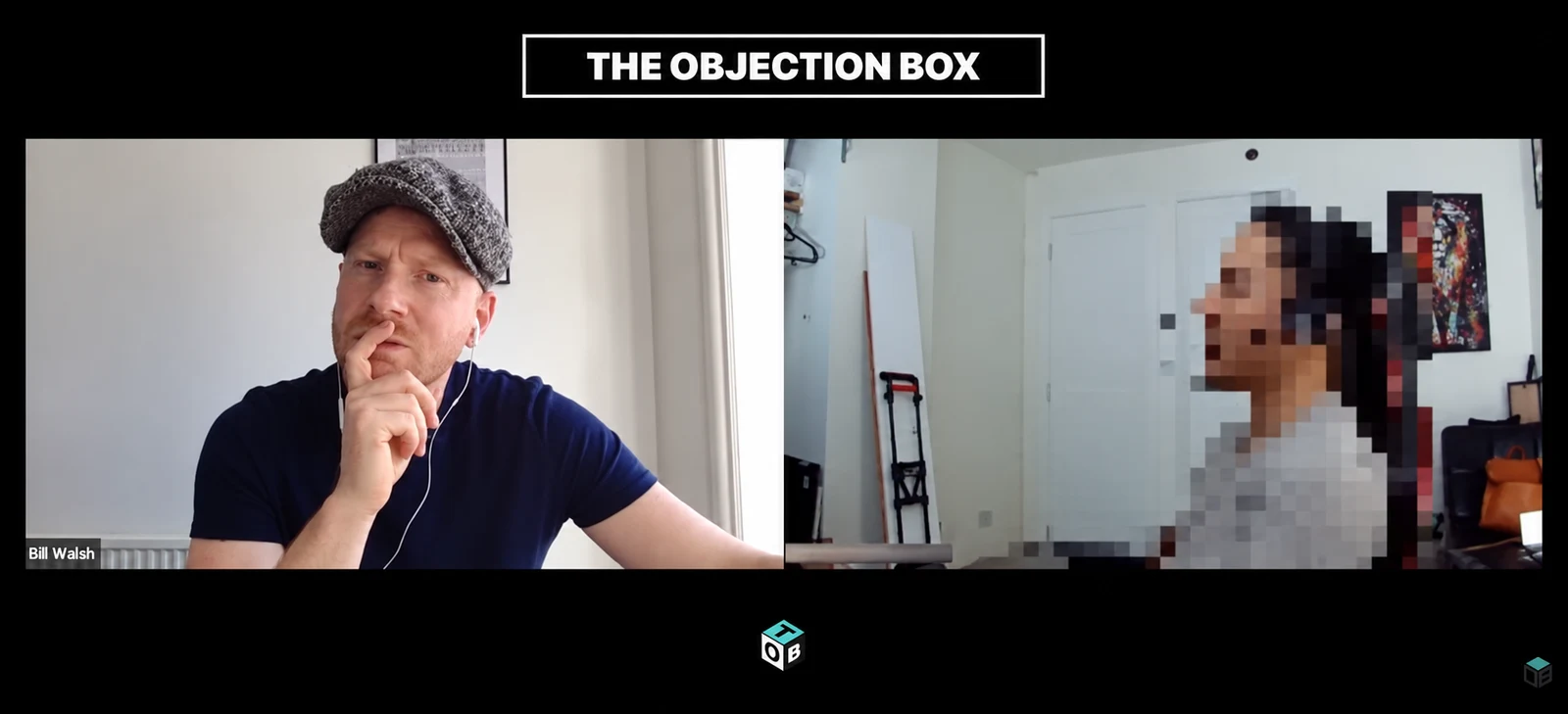
A prospect in a remote sales coaching call wants help turning training into steady action. He reports inconsistent monthly income of $3,000–$5,000. He has already bought training elsewhere, but says he did not keep putting it to work.
The coach explores his goals, explains parts of the offer, and asks for a commitment. When the prospect raises financial concerns, the discussion shifts toward his willingness to back himself. That makes this call useful to study for money objection handling.
The published captions end with agreement to a $750 deposit and the prospect going to get his card. They do not establish completed payment or later results. This Sales Room analysis uses auto-generated captions and supplied stills, not a full audiovisual review. Caption errors, gaps, or omitted discussion may change the assessment.
Watch the Original Call
The Call at a Glance
| Detail | Context |
|---|---|
| Salesperson / company | Bill Walsh, as named in the supplied stills and the original YouTube player. The video is branded The Objection Box. |
| Buyer | Prospect who describes a telecom business and a new virtual-assistant sales campaign. Source: 1:39–2:19 |
| Offer | Sales coaching with group calls, script feedback, and accountability. Source: 16:46–18:04 |
| Price | Full initial price and installment amounts are not established in the captions. The video title references $5,000; the caption track has a gap while payment options are discussed. Source: 19:14–19:40 |
| Program duration | Four months, followed by separate ongoing charges whose exact amount is not settled in this exchange. Source: 18:18–18:58 |
| Setting | Remote video call, as shown in the supplied stills. |
| Observed outcome | Verbal agreement to a $750 deposit and departure to get a card. Completed payment and later results are not shown. Source: 42:25–42:36 |
| Source scope | English auto-generated YouTube captions spanning 0:00–42:36, plus supplied stills. Whether the published recording contains the full conversation is unknown. |
The Main Takeaway
The coach makes the need for change vivid, but does less to establish why this particular purchase is the right change.
Several effective behaviors are visible. He asks for measurable goals, explores what inconsistent income means personally, offers direct script support, and eventually proposes a refundable entry arrangement.
The central weakness is that practical buying questions repeatedly become tests of courage, comfort, or self-respect. That can produce agreement without resolving whether the buyer understands the offer, can responsibly afford it, and will use it differently from his previous training.
The useful lesson is to maintain momentum while making the decision clearer. Persistence and diagnosis are different skills.
How the Call Holds Up
| Fundamental | Assessment | Evidence from the call |
|---|---|---|
| Discovery | Mixed | Establishes income, goals, stress, and inconsistent activity, but does not sufficiently investigate why execution breaks down. Source exchange |
| Decision clarity | Missed opportunity | Financial concerns recur without a clear examination of available funds, payment timing, or a complete summary of terms. Source exchange |
| Trust and listening | Mixed | Shows personal engagement and offers help, but repeatedly reinterprets the prospect’s stated concerns. Source: 21:25–22:06 |
| Value and fit | Mixed | Script review and accountability match expressed needs; the specific implementation plan remains underdeveloped. Source exchange |
| Concern resolution | Mixed | A refundable entry arrangement addresses some uncertainty, but affordability is repeatedly reframed as a confidence problem. Source exchange |
| Commitment | Mixed | Obtains a verbal deposit agreement, but earlier agreements reopen and completed payment is not shown. Source exchange |
The Moments That Mattered
1. The Prospect Identifies an Execution Problem Before the Coach Does
The exchange
The captions record the prospect saying, “I didn’t work,” about his earlier training. Read the captions at 0:40–1:13. He later identifies inconsistent dialing. See 6:14–6:43.
In the published captions, the prospect accepts responsibility for not applying his previous training. Later, he identifies inconsistent dialing as the main reason for his results.
That is valuable discovery. He is not simply asking for more information; he is describing difficulty turning information into consistent activity.
The analysis
The coach recognizes the accountability opportunity. But the transcript gives us relatively little investigation of the execution problem itself.
How many calls does the prospect currently make? What interrupts the routine? Does he avoid dialing because of rejection, uncertainty about his script, competing work, or weak targeting? What happened during his earlier stronger month? The prospect reports reaching $10,000 at 4:24–4:32.
Those answers would help distinguish a skill problem from an operating problem—or reveal that both exist.
The practical lesson
When buyers diagnose themselves, treat the explanation as a starting point. Their conclusion may be useful without being complete.
Suggested wording (example, not a call quotation)
“You mentioned inconsistent dialing. Walk me through your last working week: what did you plan to do, what actually happened, and where did it break down?”
That question could turn a broad promise of accountability into a specific coaching plan.
Use this when
A buyer has already paid for training but struggles to use it. Our cold-calling guide gives context for the calling activity being discussed. Diagnose the routine before adding another script.
2. The Income Goal Becomes Personally Meaningful
The exchange
The prospect says more consistent income would “relieve a lot of stress.” See 8:44–9:24. Later, the coach turns a low self-rating into a discussion of decision-making and self-respect. See 35:35–36:28 and 40:23–41:20.
The coach moves beyond the income target and asks what achieving it would change. The prospect describes reduced stress, greater security, and confidence affected by comparing himself with successful friends.
The analysis
This is one of the stronger discovery moments. The conversation establishes why income consistency matters to this particular buyer.
However, the coach later moves from examining performance to questioning the prospect’s self-respect and decision-making. A low rating of current business results becomes the basis for broader judgments about him.
That inference is not established by the rating. Dissatisfaction with business performance does not, by itself, prove poor judgment across decisions.
The practical lesson
Explore personal consequences without making the buyer’s worth dependent on purchasing. The goal is to understand motivation and evaluate fit.
Suggested wording (example, not a call quotation)
“You want dependable income and less stress. What would have to change in your weekly activity for that improvement to become realistic?”
This connects the emotional goal to work the program could actually support.
Use this when
A buyer describes stress or a personal goal. Bring the conversation back to specific work and a clear choice. Our examples of closing questions help you practice that transition.
3. A Question About Future Costs Gets Treated as a Distraction
The exchange
The coach describes the initial access as “four months.” He then says he does not want the prospect solving a problem four months ahead. See 18:06–19:02.
The prospect asks whether access continues after his payment plan ends. The coach explains that the program lasts four months, with an additional monthly charge afterward, but discourages focusing on that future cost.
The analysis
Clarifying the four-month duration is useful. The missed opportunity is treating the renewal question as something to defer.
A buyer asking about access and ongoing charges is evaluating the offer. That is particularly relevant when he has already disclosed inconsistent income.
The prospect also asks about one-to-one support. The coach says the program does not include dedicated one-to-one calls, while describing opportunities for individual questions within group sessions. Those distinctions deserve a concise recap before payment.
The practical lesson
Questions about duration, access, and cost are buying questions. Answering them clearly helps the prospect understand what he is committing to.
Suggested wording (example, not a call quotation)
“The initial program covers four months. Dedicated private sessions aren’t included; you can get individual feedback during the group calls. Continued access afterward is separate. Let’s confirm the initial price, payment dates, and continuation terms before you decide.”
The exact terms would need to be settled and accurately stated.
Use this when
A buyer asks about private support, access, or renewal costs. Our high-ticket sales guide explains the kind of offer being discussed and the questions to ask about it.
4. The Financial Concern Becomes a Challenge to Prove Commitment
The exchange
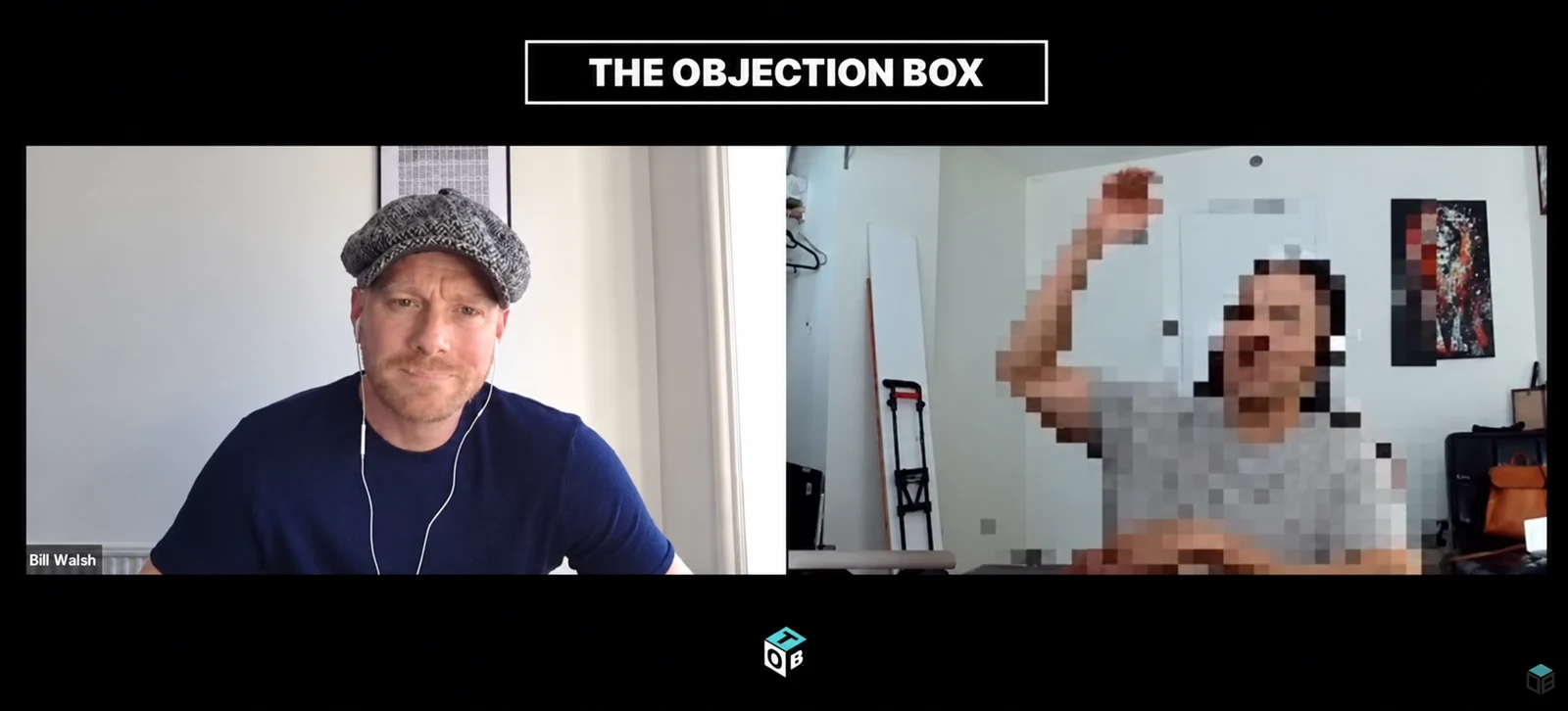
As the proposed deposit moves from $500 to $1,000, the coach says, “It’s not about the money.” See 27:31–28:34. Near the end he offers a refundable start, and the prospect agrees to $750. See 41:51–42:36.
The prospect repeatedly says money is the obstacle. The coach suggests credit, emphasizes the income potential, and presents a larger deposit as a way to become uncomfortable enough to change.
The analysis
Asking whether money is the only concern can be useful. Buyers sometimes have several unresolved questions.
Here, however, the prospect repeatedly returns to finances. The conversation does not establish enough detail to conclude that affordability is merely a confidence problem.
Increasing the proposed deposit from $500 to $1,000 is explicitly framed as a challenge. The available captions provide no evidence that the larger deposit would improve the prospect’s participation or results.
At 41:51–42:22, the coach offers something more concrete: entry with a smaller deposit, time to evaluate the coaching and arrange the balance, and a stated refund if he cannot proceed. The prospect then agrees to $750 and retrieves his card.
That sequence is observable. It does not prove which part of the conversation caused the agreement.
The practical lesson
Separate three questions:
- Does the buyer believe the offer can help?
- Can the buyer responsibly meet the payment terms?
- Will the buyer participate consistently?
A confidence-building conversation cannot answer all three.
Suggested wording (example, not a call quotation)
“Let’s separate the financial question from the participation question. What payment timing is workable for you, and what would make this different from the training you bought but didn’t consistently use?”
If offering a refundable start, confirm the deposit, balance, deadlines, access, and refund conditions in writing before collecting payment.
Use this when
Money and readiness keep returning to the conversation. Our objection-handling framework helps separate a concern from an assumed motive. For more on this skill, explore Objections & Persuasion.
The Question Worth Asking
Suggested question, not a quotation from the call:
“You already bought training you believed in. What specifically will be different about how you use this program next week?”
This gets to the central buying issue.
The prospect is not starting without training. He has already identified a gap between learning and doing. Another purchase may help, but the conversation needs to establish how.
A useful answer would identify protected calling time, participation in coaching, measurable activity, and what happens when he misses a commitment. It would also give the coach a basis for deciding whether his program fits.
Without that bridge, the buyer may be purchasing renewed motivation while the original execution problem remains.
What to Take Into Your Next Call
Repeat: Connect the buyer’s measurable goal to its personal significance. Understanding why consistency matters makes discovery more useful.
Improve: When a practical concern repeats, investigate it before reframing it. Financial constraints, uncertainty about the offer, and fear of following through can coexist.
Practice (example wording): “I hear that you want the outcome. Let’s make sure the offer, the payment terms, and the work required all fit your situation.”
The published captions end with a verbal deposit commitment. The stronger standard for closing is a buyer who can clearly explain what they are buying, why it fits, what it costs, and what they will do next.

Vianka Petines is a sharp, versatile writer with a gift for creative flair and the colorful details that make a story come alive. She covers selling skills, sales tools and the people behind the numbers. Every fact in this article links to its source; read our editorial standards.