The $3,000 AI Chatbot Sales Call: What the Demo Left Unclear
The buyer likes the automation demo. But does she understand what the price includes? A Sales Room review of scope, expectations, and the next step.
A moving-business operator wants her evenings back. In this AI chatbot sales call, she describes customer bookings, follow-up messages, and scheduling work that still require her attention. The seller proposes automation to handle more of that conversation.
The demo connects software to a recognizable problem. But late in the call, the buyer says she thought advertising was included. That is the tension worth studying: a buyer can like the solution while understanding the purchase differently.
This Sales Room review uses English auto-generated captions and two captured video frames, not a full audiovisual review. The recording contains an opening recap and a separate promotional interruption. We assess the buyer conversation; completed payment, a signed contract, and customer results are not demonstrated.
Watch the Original Call
The Call at a Glance
| Detail | Context |
|---|---|
| Salesperson / company | Pavlo, the uploader shown on the linked YouTube source (@Pavel.k). No additional company identity is assumed. |
| Buyer | Operator of a moving business who describes handling customer messages and booking coordination. Source: 3:15–4:58 |
| Offer | Proposed AI-assisted messaging and booking automation, with ongoing management. Complex mover routing and advertising are discussed separately. Source: 6:31–8:09 and 26:42–28:07 |
| Price | $3,000 setup: $1,500 initially and $1,500 on completion, plus $500 per month for management and maintenance. Additional businesses carry an unspecified extra fee. Source: 23:49–24:53 |
| Setting | Remote video conversation with a software screen share, visible in the embedded recording. |
| Observed outcome | Verbal interest in proceeding, followed by a request for an invoice outlining services and discussion of a written contract. Completed payment is not shown. Source: 28:07–28:54 |
| Source scope | Auto-generated captions spanning 0:00–30:08 and selected stills. Completeness of the underlying conversation is unknown. The opening recap and creator promotion are excluded from the assessment. |
The Main Takeaway
The seller makes the operational problem concrete. The opportunity is to make the agreement equally concrete before asking for payment.
Discovery produces specific work to address: messages, time slots, customer questions, and rescheduling. The seller also sets a useful boundary around more difficult routing work. These are stronger foundations than a generic promise that AI will save time.
Yet the late advertising question shows a gap between explaining capabilities and agreeing on deliverables. The transferable lesson from this AI chatbot sales call is to ask the buyer to describe the first version back to you. What goes live, what stays manual, and what costs extra should be shared answers.
How the Call Holds Up
| Fundamental | Assessment | Evidence from the call |
|---|---|---|
| Discovery | Strong | Asks about messaging work and follows the buyer into booking coordination and scheduling details. Source exchange: 1:44–4:58 |
| Decision clarity | Mixed | States setup and monthly prices, but the buyer later reveals a different expectation about advertising. Source: 23:49–24:13 and 26:42–27:15 |
| Trust and listening | Strong | Connects the proposal to the buyer’s workload and avoids promising complex routing that has not been established. Source: 7:39–8:09 |
| Value and fit | Mixed | The workflow addresses expressed needs, but the demonstrated prompt is a real-estate template awaiting customization. A working moving-business deployment is not demonstrated. Source: 12:02–14:01 |
| Concern resolution | Mixed | Explains the distinction between automation and advertising. The review-routing proposal still needs destination-policy checking before implementation. Source: 26:42–27:15 and 10:00–10:44 |
| Commitment | Mixed | Gets verbal agreement and asks for payment; the buyer requests written services first. The clip does not establish payment or signature. Source: 28:07–28:54 |
The Moments That Mattered
1. A Useful Boundary Around the Harder Work
The exchange
The buyer describes matching movers and routes by geography. The seller says he will not make “promises or guarantees” about that more difficult work, while bringing the discussion back to messages and booking. See 7:39–8:09.
The analysis
This is a useful act of qualification. The buyer’s desired outcome contains several jobs, and the seller does not treat them as equally simple. He identifies a narrower starting point instead of letting interest expand the promise indefinitely.
That restraint matters because the buyer is buying relief from work, not merely a chat interface. A system that answers questions but still requires manual dispatch may help, but it should not be described as solving the entire operating problem.
The practical lesson
Divide the wish list into work you can demonstrate, work you can build with agreed conditions, and work that needs investigation. Explain what the buyer will still do herself. A smaller clear promise is easier to evaluate than a large uncertain one.
Suggested wording (example, not a call quotation)
“For the first version, let’s define the messages and booking tasks we can take off your plate. Route assignment stays manual until we investigate it separately. Which remaining task would stop this first version from being useful?”
Use this when
A buyer combines several operational problems into one purchase. Our sales presentation examples help organize the pitch around the buyer’s problem; add explicit boundaries to that structure.
2. A Review Workflow Needs More Than a Technical Demonstration
The exchange
During the demo, the seller describes sending “five stars” responses toward a public review, while lower ratings go to private feedback. See 10:00–10:44.
The analysis
The technical explanation is understandable: different responses lead down different paths. But a workflow being possible does not establish that it is suitable for every destination.
The caption passage does not establish the review destination. If the workflow is intended for Google, Google’s contribution policy prohibits selectively soliciting positive reviews or discouraging negative ones. That is a reason to check the intended platform’s rules before agreeing to this design. It does not establish that a prohibited system was deployed.
This is also a scope question. Who checks the destination’s requirements? Who approves the messages? What does the system do when someone reports a bad experience? Those decisions belong in the proposed service, rather than being left to the software diagram.
The practical lesson
When selling automation that touches a third-party platform, include its operating constraints in discovery. Demonstrate the allowed workflow you intend to deliver, and separate customer feedback handling from assumptions about public reviews.
Suggested wording (example, not a call quotation)
“Which review platform will this send customers to? We should confirm its rules before designing the routing. Let’s agree how every customer can give feedback and how your team responds when something needs attention.”
Use this when
Your offer sends messages, requests reviews, or moves information between services. The questions in our sales tools guide provide broader context for evaluating software; a working connection alone does not settle the operating requirements.
3. The Buyer Likes the Demo but Expects More in the Package
The exchange
Late in the call, the buyer says she thought funnels and advertising were “part of this.” The seller explains the difference between the infrastructure and bringing traffic to it. See 26:42–27:15.
The analysis
This is the most consequential clarity gap in the AI chatbot sales call. The buyer has been responding positively, but that enthusiasm has not settled which commercial outcome she expects the price to cover.
The seller’s explanation helps separate two different services. It would have been more useful before the price and payment discussion, when the buyer could evaluate the proposed package with that distinction already in mind.
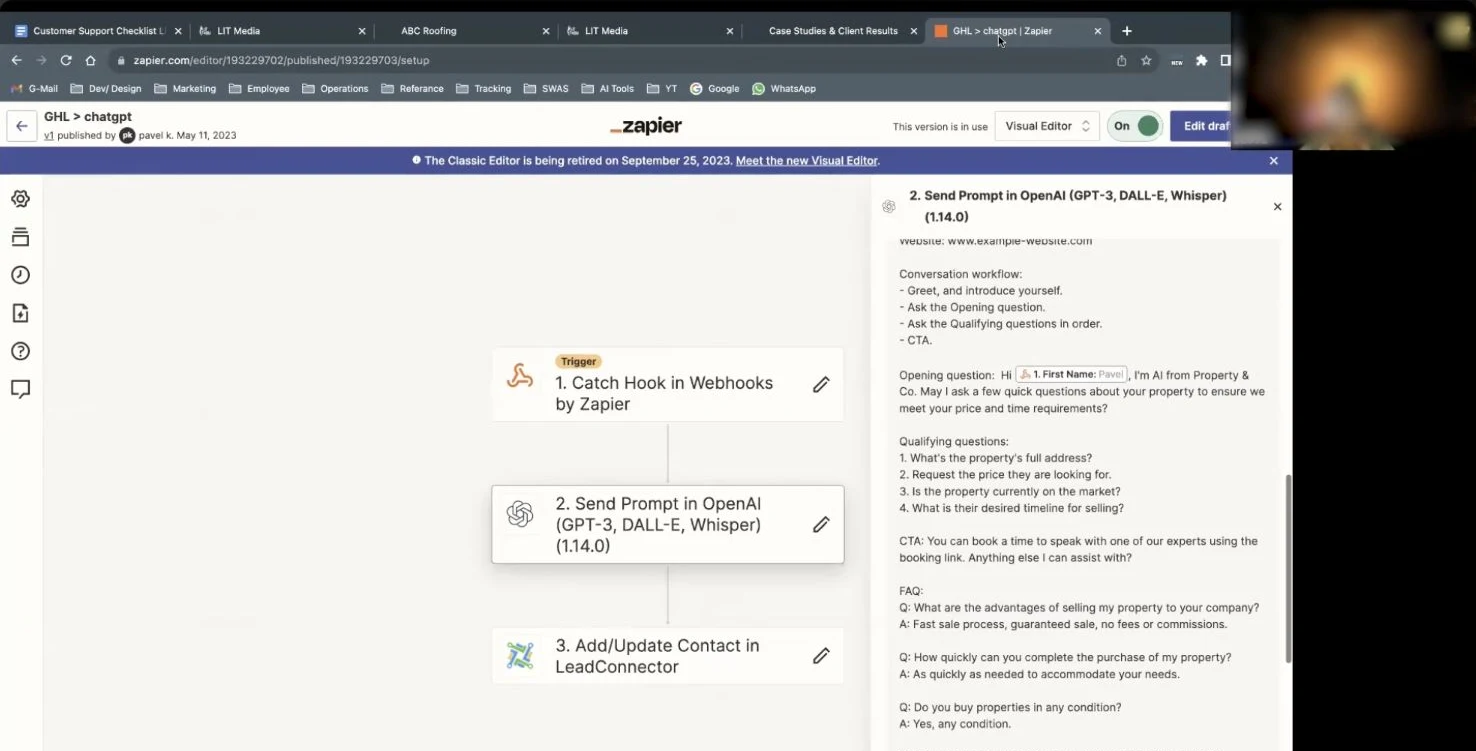
The screen share also deserves careful framing. At 12:02–14:01, the demonstrated prompt uses a real-estate example that the seller says will be customized. It illustrates an approach. It does not demonstrate an already configured system handling this buyer’s moving jobs.
The buyer later estimates that automation could save half her day, at 22:15–22:30. That is her expectation, not a measured result. A stronger next step would translate that hope into tasks and acceptance checks without promising a specific time saving.
The practical lesson
After a demo, ask the buyer to summarize what she thinks she is buying. Listen for additions, especially lead generation, advertising, extra businesses, or ongoing support. Correct the package while agreement is still easy to revise.
Suggested wording (example, not a call quotation)
“Before we discuss payment, how would you describe what this first project includes? I want to check that we agree on the customer messages, booking workflow, and handoffs. Advertising and additional businesses would need a separate scope and price.”
Use this when
A demo covers several related capabilities. Our closing questions offer ways to test readiness. Here, the useful test is whether both people can describe the same purchase, not simply whether the buyer likes it.
4. The Request for Written Services Defines the Real Next Step
The exchange
After verbal agreement and a request for a card, the buyer asks for an invoice with “services and such outlined.” The seller proposes sending a contract. See 28:15–28:54.
The analysis
The buyer supplies a practical next step: put the services in writing. That should sharpen the sale rather than stall it. The conversation has covered automation, maintenance, advertising, and additional businesses, so a written summary can expose remaining differences.
The stated terms at 23:49–24:13 separate the setup into two payments and add monthly management. What counts as completion still needs an agreed definition. A payment trigger is clearer when the buyer knows which tests or deliverables satisfy it.
The published ending supports a verbal willingness to proceed and an intended document exchange. It does not support declaring a completed $3,000 transaction, successful launch, or proven return on investment.
The practical lesson
Close on an observable action. A written scope should name the first-version tasks, exclusions, dependencies, acceptance checks, charges, and the next review step. Do not treat a requested document as if it has already been accepted.
Suggested wording (example, not a call quotation)
“I’ll send the proposed services, exclusions, payment stages, and monthly management terms. Let’s review what completion means together before the first payment. What else needs to be clear for you to make that decision?”
Use this when
A buyer asks for an invoice, contract, or service summary before paying. Use our sales-call follow-up email guide to make the promised document and next action easy to find. More software coverage sits in Sales Tech & AI.
The Question Worth Asking
Suggested question, not a quotation from the call:
“What would you expect the first version to handle on its own, and what would you still expect to do yourself?”
This invites the buyer to describe the purchase in operational terms. An answer about new leads would expose the advertising expectation. An answer about assigning movers would reopen the routing boundary. An answer about booking changes would help define a testable first version.
The seller could then correct the scope, investigate an uncertainty, or price a separate project. That makes the decision more informed without draining the enthusiasm from the call.
What to Take Into Your Next Call
Repeat: Tie the proposal to specific work the buyer already does, and state where your confidence ends.
Improve: Confirm the buyer’s understanding of included work, exclusions, and completion before moving into payment.
Practice (example wording): “Walk me through what you expect this system to do after launch. Let’s mark what is included now and what needs a separate decision.”

Mara Alcantara is a tech-savvy writer with a creative eye who tends to see life in color. Pairing an analytical mind with a knack for spotting talent, she writes profiles of the people who sell for a living and breaks down the habits behind their numbers. Every fact in this article links to its source; read our editorial standards.