Grant Cardone vs Jordan Belfort: The Sales Room Scorecard
Their 2019 Wolf's Den episode went viral for the trash talk. We scored the selling: 12 rounds, one checklist, and the lines worth stealing.
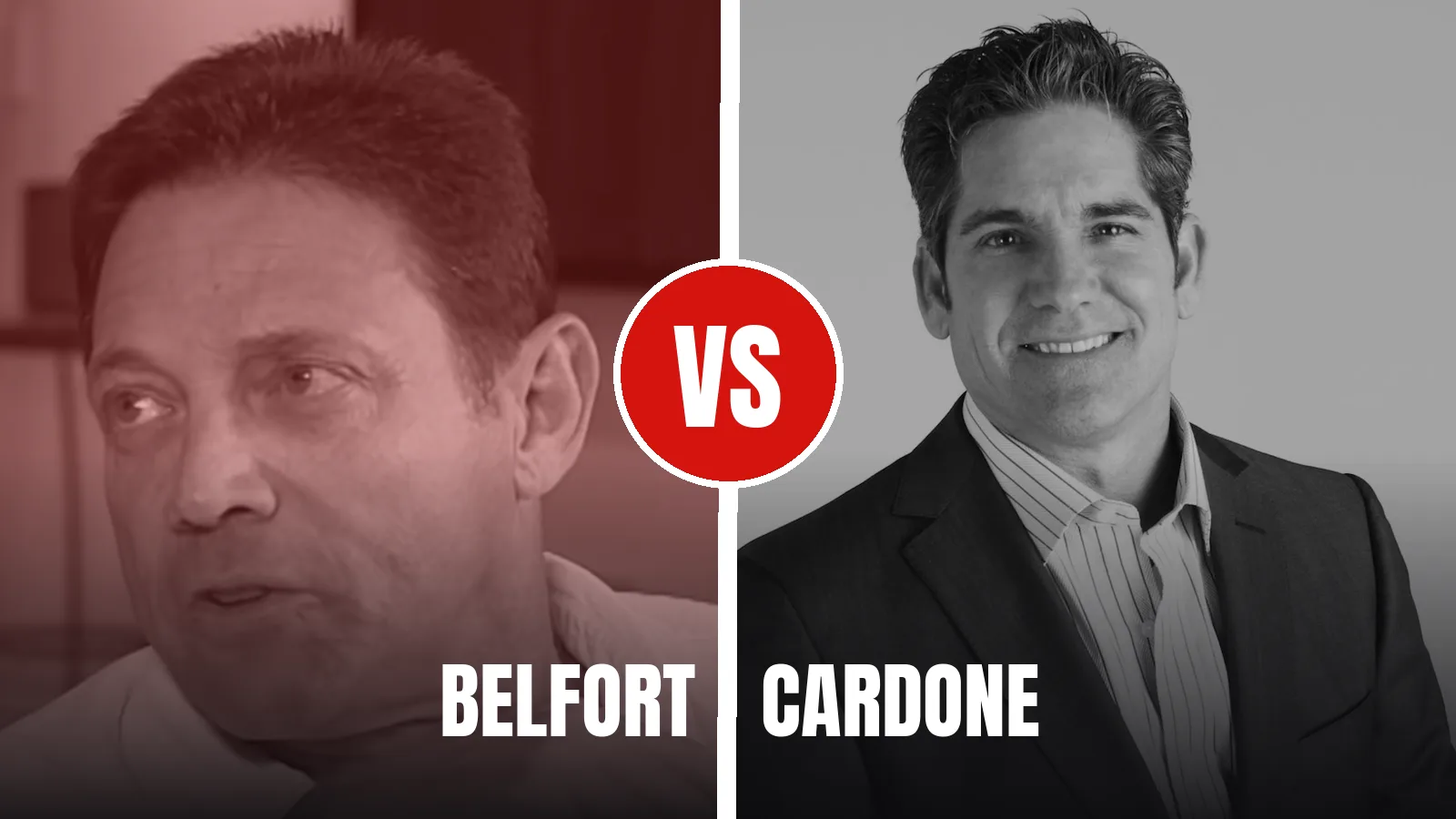
In their 2019 Wolf's Den episode, Grant Cardone vs Jordan Belfort comes out 7 rounds to 5 for Cardone on our scorecard. Cardone won on volume, follow-up, price and coaching systems. Belfort won on knowing when to move on, listening and making the next step easy. Both agreed reps stay on calls too long.
In August 2019, Jordan Belfort sat Grant Cardone down for episode 14 of The Wolf's Den, Belfort's podcast. The video title called it a "Sales Training Heavyweight Match." Eighty minutes later, they had argued about cold calling, joked about a cage match and agreed on more than either would admit.
The video has passed 3.4 million views. People still search Grant Cardone vs Jordan Belfort because they want to know who won. So we scored it.
We read the full auto-generated captions, 0:00 to 80:11, and judged 12 sales standards round by round. Here's who handled each one better, where both slipped, and what you can steal for your next call.
KEY TAKEAWAYS
- Volume wins, but only with qualified people: Cardone's numbers game needs Belfort's rule about when to move on.
- Put the price on the table early, and follow up on every door you knock.
- Coach talk time: both men agreed reps left alone stay too long with people who won't buy.
Watch the Grant Cardone and Jordan Belfort podcast
One note before the scorecard. The episode includes three sponsor reads by Belfort. We use them in two rounds on purpose: they are the only place in the episode where you hear Belfort pitch a product from start to finish.
The matchup at a glance
| Detail | What the source shows |
|---|---|
| Episode | Grant Cardone vs Jordan Belfort | Sales Training Heavyweight Match, The Wolf's Den #14 |
| Posted | August 13, 2019, on Belfort's YouTube channel |
| Length | 1 hour, 20 minutes |
| Host | Jordan Belfort, asking the questions |
| Methods on the card | The episode description frames it as "Ten Times Vs. The Straight Line": Cardone's 10X against Belfort's Straight Line |
| Our source | Auto-generated English captions, 0:00 to 80:11. Captions don't label speakers, so we only credit a line to someone when the exchange makes the speaker clear. This is not a full audiovisual review. |
Grant Cardone vs Jordan Belfort: who did it better?
Twelve standards every seller gets judged on. A check means that person handled it better in this episode. Not over their careers, and not in their courses. In these 80 minutes.
THE SALES ROOM SCORECARD
| The standard | Belfort | Cardone |
|---|---|---|
| Prospecting volumeCardone made the case for activity: you can't close conversations you never start. | ✓ | |
| Knowing when to move onBelfort kept pressing on reps who stay too long with people who can't buy. Cardone ended up agreeing. | ✓ | |
| Defining a qualified buyerCardone gave the episode's clearest checklist: decision-maker, money, interest, need. | ✓ | |
| Follow-upCardone: most people knock once and never go back. "The gold is in the follow up." | ✓ | |
| Putting the price on the tableCardone says price should come early. Belfort's first sponsor read didn't know the price. | ✓ | |
| Listening and asking questionsBelfort asked open questions and let them run. Cardone called one of them "a bad question." | ✓ | |
| Painting the pictureBelfort sold the feeling of owning it, not the specs. Big unproven claims cost him points. | ✓ | |
| Making the next step easyBelfort asked for a small, low-risk step instead of the sale. | ✓ | |
| Coaching and accountabilityCardone named his system: record every call, review it, train twice a day, track the numbers. | ✓ | |
| Beating a slumpCardone's best minute: help someone else with their leads until you loosen up. | ✓ | |
| Staying composed under pushback"Reasonable minds could differ" beats "you're wrong" in any sales conversation. | ✓ | |
| Closing a dealCardone told the only full close in the episode: a cold call on an off-market property. | ✓ | |
| Rounds won | 5 | 7 |
✓ = handled it better in this episode. = means a draw. Judged from the episode's captions, round by round below.
Round by round: what each one got right
Round 1: Prospecting volume
What they said
Cardone: "there's no success without volume" (13:53). Later he put numbers on it: if one rep talks to 10 people a day and another talks to 200, "the guy that talks to 200 is gonna win the game" (36:09).
The edge
Cardone. Belfort never argued against activity. His questions were about where the activity goes. Cardone's point holds for most reps: you can't close a conversation you never start.
What to steal (example)
Set the number before the day starts: "Today is 80 dials and 15 real conversations. I don't stop until both are done." Need words for those dials? Start with our cold calling scripts, or go back to basics with what cold calling is. More in our Prospecting and Pipeline section.
Round 2: Knowing when to move on
What they said
Belfort's question: a rep with 200 leads spends 45 minutes pitching a $10,000 product to someone with no money and no job. "Would that be smart or not smart?" (16:39). Cardone answered that a company shouldn't sell only one product (17:14). Belfort came back to it later: left to their own devices, reps "will tend to totally stay too long on a call" (43:16). Cardone: "I agree that they would, yes" (43:50).
The edge
Belfort. He asked the question every sales manager lives with, kept asking it and got Cardone to agree. Cardone's point about a wider product range is fair business advice, but it dodged the rep's problem. The 45 minutes are gone either way.
What to steal (example)
Give every call an exit test: "Before I take more of your time, is fixing this a priority in the next 90 days?" If the answer is no, book a follow-up date and dial the next number.
Round 3: Defining a qualified buyer
What they said
Cardone: "the trick is the call, the trick is a good contact, the trick is that they're qualified to buy from us," which he spelled out as a decision-maker who has the money, the interest and the need (45:28).
The edge
Cardone. Belfort raised the problem, and Cardone gave the clearest answer to it in the whole episode. Decision-maker, money, interest, need: a checklist you can run in two minutes.
What to steal (example)
"Who else weighs in on a decision like this? And if it makes sense, is the budget already set aside, or would we need to find it?"
Round 4: Follow-up
What they said
Cardone: most door knockers work a neighborhood once and never go back, but he goes back, because "the gold is in the follow up" (14:27).
The edge
Cardone. Belfort didn't push back, and the example is concrete. The second knock on the same street is where most reps have already quit.
What to steal (example)
Log every "not now" with a date: "Totally fair. I'm back in this neighborhood on the 14th. Mind if I knock again then?" For the email version, see our follow-up email after a sales call.
Round 5: Putting the price on the table
What they said
Asked for his strategy once a buyer is qualified, Cardone laid it out: what the product does, what it costs, "that should come early by the way," then "does it fit your needs?" (49:15). In his first sponsor read, Belfort said, "I don't know the price right here," and sent viewers to the website (7:45).
The edge
Cardone. An early price works as a filter. It saves both sides time, and it tells the buyer you have nothing to hide. A sponsor read isn't a sales call, but not knowing the number is still the moment a buyer remembers.
What to steal (example)
"It's $4,800 for the year. Before I go further, is that in the range you expected?"
Round 6: Listening and asking questions
What they said
Belfort opened by saying he wanted to "extract as much as I can from you" (0:32), then kept asking open questions: when did you start selling (1:09), and what was your pitch back then (3:22). When he asked where the sweet spot is between more doors and deeper calls, Cardone answered, "I think it's a bad question" (15:01).
The edge
Belfort. He was the host, so asking was his job. The contrast still teaches: his open questions got Cardone telling stories for minutes, while calling a question bad shut a useful thread down.
What to steal (example)
When a buyer's question sounds off, find out what's behind it: "Good question. What's making you ask?"
Round 7: Painting the picture
What they said
In the watch sponsor read, Belfort sold the feeling, not the specs. Watches all tell time now, so "it's about how do they look, how do they feel, what does it say about you," and then: "just imagine how good you feel" (23:59).
The edge
Belfort, with a catch. He moved the listener from features to the moment of wearing the thing. But he also made claims nobody can check on air, like earbud quality "twice as good as anything else out there" (7:45). Paint the picture with what you can prove.
What to steal (example)
"Picture Monday at 8 a.m. The report is already in your inbox, and you didn't build it."
Round 8: Making the next step easy
What they said
Belfort closed the watch read with a small ask: "if nothing more, just go to the website, just check out the watches. What's the worst that could happen?" (23:25). Cardone's version of the close is "if not today, when" (49:15).
The edge
Belfort. He asked for a step the listener could take with no risk. Cardone's question is honest and direct, but it asks for a bigger commitment from someone who may not be ready.
What to steal (example)
"Worst case, you see the numbers and say no. Can we look at them Thursday at 2?"

Round 9: Coaching and accountability
What they said
Cardone described his Miami phone team: every call recorded, every call reviewed by QC and management, training every morning and every night. "If the program works, the stats should go up" (41:40). On long calls, he said a manager should look at "number of calls, not just calls" and "talk time" (43:16). Belfort said he tries to "instill procedures" to stop long calls (43:50), but the captions don't show what those procedures are.
The edge
Cardone. He named his system: record, review, train, measure. Belfort had the right worry and no stated fix.
What to steal (example)
For managers: pull three recorded calls a week, score the first 60 seconds, and coach one change. Our guide on how to coach sales reps has the full loop.
Round 10: Beating a slump
What they said
Cardone: in a slump, "the thing that has never let me down is helping somebody else." He'd ask a teammate for yesterday's list and call it for nothing, just to stop pressing on his own deals (37:14).
The edge
Cardone, uncontested. It may be the most useful minute of the episode. You loosen up, you get reps back, and a teammate gets free pipeline.
What to steal (example)
"I'm in a rut. Give me five of your dead leads. I'll call them today, and anything that books is yours."
Round 11: Staying composed under pushback
What they said
When they split on "not interested," Belfort said: "I disagree with that, but I must say that reasonable minds could differ" (40:32). He also called Cardone "a killer marketer" (49:49). Cardone told Belfort "you're wrong" (41:06) and, as the episode description puts it, challenged him to a cage match (72:03).
The edge
Belfort. The cage match was played for laughs, and it helped the clip spread. In a sales conversation, though, "reasonable minds could differ" keeps the buyer talking. "You're wrong" ends the conversation.
What to steal (example)
"I see it differently, and I might be missing something. Walk me through how you got there."
Round 12: Closing a deal
What they said
Cardone told the story of cold calling the owner of an apartment property that wasn't on the market: "you tell me the price, you tell me the terms, you tell me the closing date," adding they closed 60 days later (74:50). That's his account; the episode doesn't show documents.
The edge
Cardone. It's the only full close described in the episode: a cold call, a clear ask and a closed deal, by his telling. The captions show no close of Belfort's own in these 80 minutes.
What to steal (example)
"What would it take for you to say yes this month? Price, terms, timing. Tell me, and I'll tell you if I can do it." More ways to ask in our closing questions examples.
Where did Cardone and Belfort agree?
Under the trash talk, the two agreed on three things that matter more than who won.
- Reps stay on calls too long. Belfort said it, and Cardone agreed (43:50).
- Talk time is a manager's job. Cardone wants calls and talk time tracked. Belfort wants procedures that rein reps in.
- Sales and marketing need each other. Belfort praised Cardone's marketing (49:49), and near the end Cardone said you won't have one without the other (78:41).
Put them together and you get one system worth running: Cardone's volume, run through Belfort's filter.
Who didn't do so well?
Cardone's weakest moment: "not interested" is a level of interest
Cardone argued twice that "not interested" is still a level of interest, because "zero, none is a quantity" (6:04, 39:59).
As a way to take rejection less personally, fine. As a rule for where a rep spends the next 45 minutes, it costs money. It also clashes with how Cardone described his own pitch early in the episode: be direct, "find out if you're interested, then I move on" (3:54). The slogan got the attention. The earlier rule is the one to use.
Belfort's weakest moment: big claims, no price
Belfort's sponsor reads showed real skill at painting a picture. They also leaned on claims a buyer can't check: earbuds "twice as good as anything else out there" and a $200 watch that "should be honestly $10,000" (7:45, 22:51).
Add "I don't know the price right here," and you have a pitch built on energy, not proof. In the debate itself, he named the long-call problem but never stated his own rule for ending a call. Careful buyers trust the seller who knows the number and has a rule.
What should you take into your next call?
Whether you lean toward Grant Cardone's sales training or Jordan Belfort's Straight Line selling, this episode gives you three habits to work on this week.
- Repeat: Cardone's volume. Set a daily conversation number and hit it before you judge your results.
- Improve: Belfort's exit test. Ask the priority question early, and stop pitching people who can't buy this quarter. Our guide to the "let me think about it" objection helps with the stalls this uncovers.
- Practice: Say your price out loud in the first five minutes of your next three calls, then ask, "Is that in the range you expected?"
Who's next? Nominate the next sales head-to-head
Three matchups we'd want to score next, all from our Featured Closers:
- Jeremy Miner, creator of NEPQ, vs Cole Gordon, founder of Closers.io
- Ryan Stewman of Hardcore Closer vs Greg Pahel of Clever Closers
- Ava Mistruzzi of Her Closing Academy vs Kayla Hodges of Elite Sales Women
Got a better one? Send it below.
Frequently asked questions
Who won Grant Cardone vs Jordan Belfort?
There's no official winner, and the episode doesn't name one. On our scorecard, Cardone takes 7 of 12 rounds, winning on volume, follow-up, price and coaching. Belfort takes 5, winning on knowing when to move on, listening and making the next step easy.
What podcast did Grant Cardone and Jordan Belfort argue on?
It was episode 14 of The Wolf's Den, Jordan Belfort's podcast, posted to his YouTube channel on August 13, 2019. The full interview runs 1 hour and 20 minutes and is titled "Grant Cardone vs Jordan Belfort | Sales Training Heavyweight Match."
What's the difference between Grant Cardone's and Jordan Belfort's sales training?
In this episode, Cardone's approach is volume and follow-up: talk to more people, go back to every door and put the price out early. Belfort's questions push on control of the call: qualify fast and stop pitching people who can't buy. The episode description frames it as "Ten Times Vs. The Straight Line."
Did Grant Cardone challenge Jordan Belfort to a cage match?
Yes. Around the 72-minute mark, Cardone proposed a three-round cage match with 90 days to prepare and the money going to charity. They traded jokes about training time and pay-per-view, then moved on. It was half joke, half promotion, and it helped the clip spread.
Is "not interested" really a level of interest?
Cardone argues it is, because zero is still a quantity. That's a useful way to take rejection less personally. As a rule for how long to stay on a call, it costs reps time, and earlier in the same episode Cardone describes his own pitch as finding out if someone is interested, then moving on.
What can salespeople learn from Jordan Belfort's sales pitch in the episode?
Belfort's sponsor reads show two strong habits: sell the feeling of owning the product, and ask for a small next step instead of the sale. The miss is proof. Claims like "twice as good as anything else" and not knowing the price weaken trust with careful buyers.

Vianka Petines is a sharp, versatile writer with a gift for creative flair and the colorful details that make a story come alive. She covers selling skills, sales tools and the people behind the numbers. Every fact in this article links to its source; read our editorial standards.